Brazil’s relationship with water has never been simple. A country of continental scale, with the Amazon’s extraordinary abundance in the north and the chronic scarcity of the semi-arid northeast, has always required differentiated infrastructure strategies across its regions. But climate change is now compounding this natural complexity in ways that challenge assumptions that have underwritten infrastructure investment for decades.
The evidence is accumulating rapidly. Government data shows a 460% increase in climate-related disasters in Brazil since the 1990s, with nearly 92% of municipalities having recorded at least one such disaster. A USP and INPE research study projects that climate change could drastically reduce aquifer recharge across the country, particularly in the Southeast and South, where temperature increases and changes in rainfall patterns are expected to reduce groundwater renewal capacity significantly. And surface water sources, on which a substantial portion of Brazil’s treatment infrastructure depends, are subject to increasing variability in both quantity and quality.
For utilities, concessionaires, and capital planners making long-term infrastructure investment decisions, this is not a background condition to be noted in a risk section of a project document. It is a central variable that should be shaping what gets built, where, and to what specification.
The Surface Water Vulnerability
Surface water sources, rivers, reservoirs, and lakes, are more immediately sensitive to climate variability than groundwater. When rainfall patterns shift, river flows change, sometimes drastically. When temperatures rise, evaporation from reservoirs increases and seasonal flow patterns compress. When land use upstream degrades, sediment loads and pollutant concentrations increase. And when extreme events, both droughts and floods, intensify, the reliability of surface water sources becomes harder to guarantee.
In Brazil, the consequences of surface water variability are well documented. The 2014 to 2016 drought that devastated Sao Paulo’s Cantareira reservoir system, reducing it to near-zero storage and forcing the city to implement emergency water rationing, was a severe demonstration of what climate stress on surface water infrastructure can look like. The World Resources Institute has noted that most Brazilian cities rely almost exclusively on grey infrastructure, treatment plants and reservoirs, for their water supply, with limited use of the natural infrastructure that could buffer against source water variability.
For capital planners, the implication is direct: investments in surface water treatment infrastructure need to be stress-tested against a wider range of source water scenarios than has historically been standard practice. A treatment plant designed for the average flow conditions and quality parameters of the last two decades may not be fit for the conditions of the next two.
What Climate Risk Means for Treatment Plant Specification
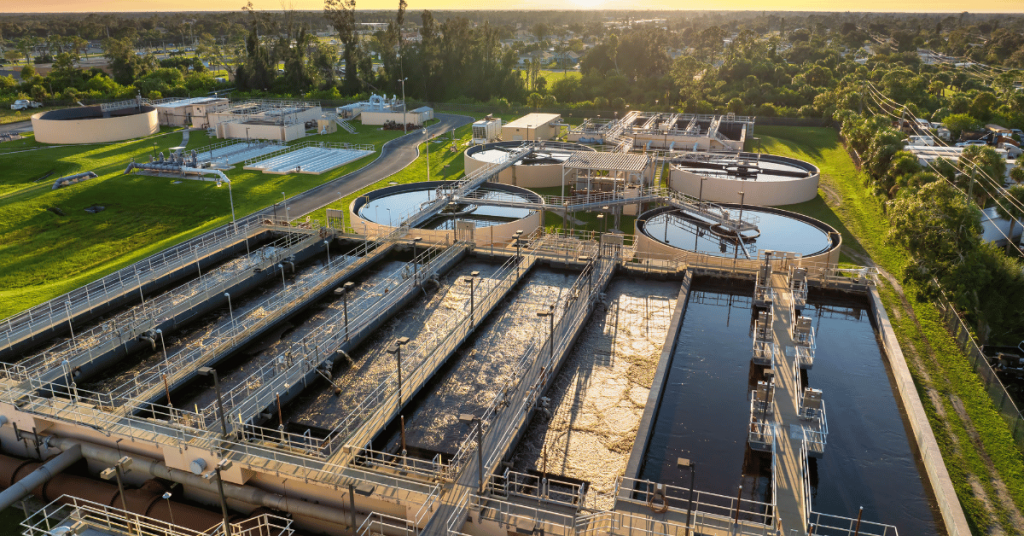
Climate risk manifests in treatment plant design in several specific ways. Variable source water quality, driven by more intense rainfall events that increase turbidity and pollutant concentrations, requires treatment capacity that can handle a wider range of influent conditions. Reduced dry season flows may require either additional storage capacity or treatment technologies that can operate effectively at lower utilisation rates. And increasing temperatures may affect the performance of biological treatment processes in ways that require design adjustments.
These are not hypothetical future concerns. They are present-tense design challenges that engineers working on Brazilian water infrastructure projects are already grappling with. The question is whether the planning and design process gives them the tools to address these challenges systematically, or whether climate risk remains a qualitative acknowledgment rather than a quantitative input to design decisions.
Generative design platforms that can model multiple source water scenarios, varying influent quality, flow rates, and seasonal patterns, provide a mechanism for stress-testing treatment plant designs against realistic climate risk assumptions before commitments are made. When a platform like the Transcend Design Generator generates design options with detailed CAPEX and OPEX analysis, the ability to run those analyses against different source water scenarios transforms climate risk from a qualitative concern into a quantified input to investment decisions.
Groundwater as a Complement, Not an Alternative
The climate vulnerability of surface water sources has prompted renewed interest in groundwater development across several Brazilian regions. Research from USP and INPE notes that cities supplied exclusively by groundwater during the 2014-2016 drought were twice as insulated from the water crisis as those dependent on surface sources. In Sao Paulo, groundwater currently supplies only 1% of public supply, a figure that reflects historical underinvestment in what could be a significant resilience resource.
But groundwater is not a straightforward alternative. The same research projects that aquifer recharge across much of Brazil will decrease significantly under both moderate and pessimistic climate scenarios. Groundwater that is not being replenished is a depleting resource, not a permanent solution.
The capital planning implication is that resilient water supply in climate-stressed regions requires diversified source strategies: surface water infrastructure designed to handle greater variability, groundwater development where aquifer conditions permit, and potentially investment in natural infrastructure, watershed management, and wetland restoration, that reduces the vulnerability of source water to climate stress. The G20 Climate Risk Atlas assessment for Brazil makes clear that without urgent investment in climate resilience, Brazil faces cumulative economic losses of up to 7.35% of GDP by 2100.
Rethinking the Investment Horizon
Perhaps the most fundamental implication of climate risk for capital planning is the need to extend the investment horizon over which infrastructure decisions are evaluated. A treatment plant built today will be in service in 2055. The climate conditions it will need to operate under for much of its life are materially different from those of today. A planning process that evaluates investment options based on current conditions, without accounting for how those conditions are likely to change, is systematically underestimating risk.
Dynamic capital planning tools that enable scenario modelling across different climate trajectories are essential for addressing this problem. They allow planning teams to test investment options not just against current conditions, but against a range of plausible future states, and to identify the options that are most robust across that range.
This is not about predicting the future with precision. It is about making investment decisions that hold up well across a range of plausible futures, rather than decisions that are optimised for a single assumed future that may not materialise. In Brazil’s increasingly volatile climate context, that distinction is becoming one of the most important dimensions of infrastructure capital planning.
To explore how Transcend supports climate-adaptive infrastructure design and capital planning, visit transcendinfra.com/capitalplanning.