The scale of the investment
The Netherlands continues to face increasing pressure on wastewater treatment infrastructure. Urban expansion, industrial activity, tightening environmental requirements, and long-term resilience planning are all accelerating across the Randstad region. The country’s 21 regional water authorities have committed to investing 3.3 billion euros per year between 2026 and 2030, totalling 16.5 billion euros over five years. RWZI investment alone has risen from 1.085 billion to 1.290 billion euros per year.
The regulatory environment is also shifting. The revised EU Urban Wastewater Treatment Directive, which entered into force in January 2025, introduces nutrient removal requirements for large plants by 2039. By 2045, mandatory micropollutant treatment applies. For facilities being planned today, these are not future considerations. They are design inputs.
Large metropolitan corridors such as Rotterdam and The Hague require continuous investment in treatment capacity to support future growth. Strict effluent requirements for nitrogen, phosphorus, suspended solids, and receiving water quality must be maintained throughout. At the same time, engineering teams are expected to evaluate multiple treatment strategies, layouts, and operational approaches within increasingly compressed project timelines.
A conceptual wastewater treatment design for the Randstad
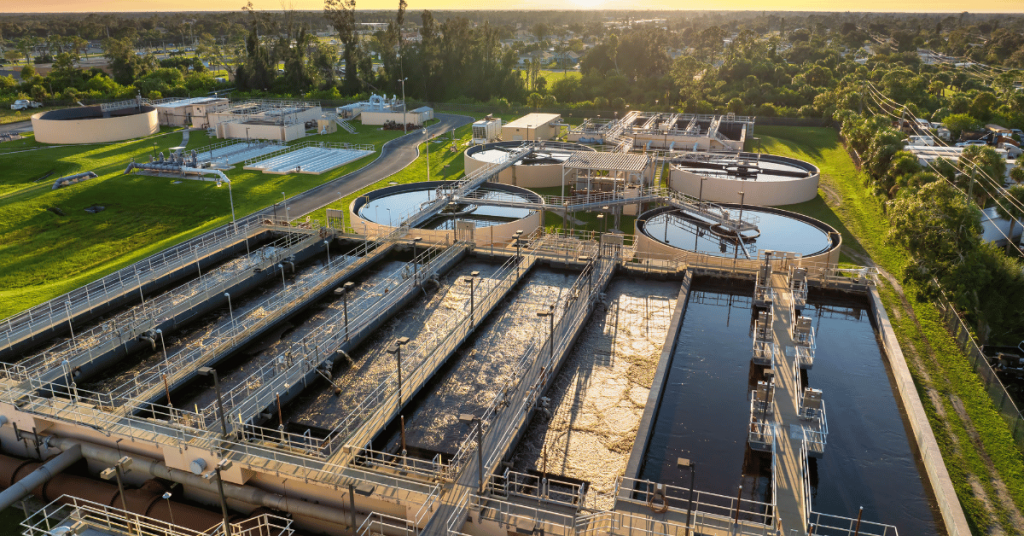
As a conceptual engineering exercise using the Transcend Design Generator (TDG), we generated a 200,000 m3/d regional relief Water Resource Recovery Facility (WRRF) concept located near Maasdijk, strategically positioned between the Rotterdam and Hague metropolitan areas. The location provides a realistic balance between regional accessibility, hydraulic connectivity, and the availability of land suitable for large-scale infrastructure expansion.
The generated concept includes a full conventional activated sludge (CAS) treatment train using an MLE nutrient removal configuration, primary clarification, chemical phosphorus removal, UV disinfection, sludge thickening, blending, and dewatering systems. The process was dynamically sized using simulation-driven engineering workflows to achieve the target effluent requirements under the provided loading and operational conditions.
From isolated calculations to coordinated engineering output
The project demonstrates how modern infrastructure optioneering can move beyond isolated calculations and disconnected deliverables. Instead of manually building preliminary concepts across multiple software platforms over extended periods of time, engineering teams can rapidly generate coordinated technical outputs directly from the process design itself.
The resulting engineering package spans multiple disciplines simultaneously. Process deliverables include technical descriptions, process flow diagrams, P&IDs, operational process data, and detailed mass balances. Civil and layout deliverables include coordinated site layouts and civil Revit models suitable for preliminary planning. Mechanical and operational outputs include equipment schedules, valve and instrumentation data, and bills of quantities. Engineering teams can move rapidly from conceptual discussions into coordinated documentation without rebuilding information between tools.
This significantly accelerates the early project lifecycle while maintaining consistency across engineering outputs. Instead of rebuilding information manually between disconnected tools and document sets, engineering teams can evaluate and iterate on complete infrastructure concepts within a unified engineering environment.
Evaluating alternatives within the same environment
This concept focused on a conventional activated sludge configuration. However, TDG supports a broad range of wastewater treatment technologies used across the Dutch water sector. This includes biological nutrient removal configurations, tertiary treatment systems, sludge handling solutions, and technologies developed in partnership with Haskoning. Different treatment strategies can be evaluated rapidly within the same engineering environment. Teams can compare process performance, operational complexity, footprint requirements, and equipment impacts early in the project lifecycle.
For utility decision makers evaluating new treatment capacity or compliance upgrade pathways, the ability to compare complete, coordinated engineering alternatives at the conceptual stage changes what is possible in early project planning.
See it in practice
The Randstad Relief Plant concept is a concrete illustration of what generative wastewater treatment design looks like in a Dutch planning context. The full sample output pack includes preliminary engineering deliverables generated from this concept, formatted to reflect Dutch design requirements.
If you are evaluating how this approach could support planning work at your organisation, we would welcome the conversation.