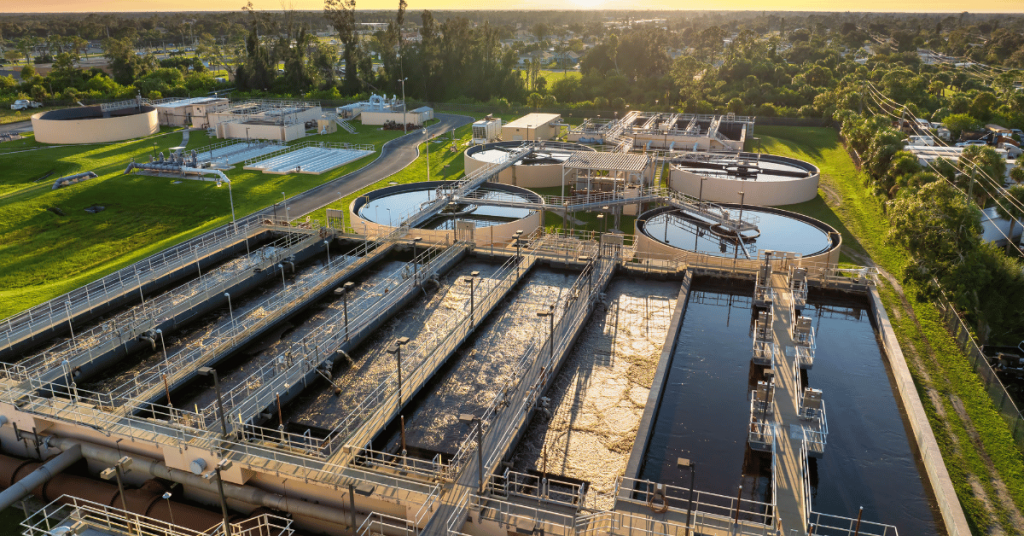
The fundamental premise of infrastructure design has always been that the future will be sufficiently like the past that designing for historical conditions provides a reasonable basis for designing for future ones. In stable environments, that premise works well enough. The problem is that the operating environment for surface water treatment infrastructure is no longer stable in the ways that matter most for design.
Source water quality is changing, driven by climate variability, changing land use, and the emergence of new contaminant classes. Regulatory requirements are evolving as scientific understanding of health risks improves. Treatment technology is advancing rapidly, creating options that were not available when many existing facilities were designed. And the demand placed on treatment infrastructure is growing as populations expand and expectations for water quality rise.
In this environment, designing for a single assumed future, optimising a treatment system for the conditions of today extrapolated forward, is a fundamentally inadequate approach. Scenario modelling, the practice of explicitly evaluating how a design performs across multiple possible futures, is not a premium analytical option for large or unusually complex projects. It is a basic requirement for sound infrastructure investment in a sector characterised by uncertainty and long asset lives.
What Scenario Modelling Addresses in Surface Water Treatment
Scenario modelling for surface water treatment needs to address at least three categories of uncertainty: source water variability, regulatory evolution, and technology change.
Source water variability scenarios should cover the range of influent quality conditions the plant is likely to face over its operational life: not just the average and design day conditions, but the extreme events, the seasonal patterns, and the longer-term trends that climate change and catchment dynamics may produce. For each scenario, the design should be evaluated for its ability to meet treatment objectives and maintain operational flexibility.
Regulatory evolution scenarios should address the possibility that treatment standards will become more stringent over the facility’s operational life. The pattern in drinking water regulation is consistently toward tighter standards as more is learned about contaminant health effects. A facility that just meets current standards at commissioning may struggle to meet the standards that apply in year 15 or year 20 of its life. Design decisions that build in treatment capacity or flexibility for potential future requirements reduce the risk of costly upgrades later.
Technology change scenarios are less commonly considered but increasingly important. Surface water treatment technology is evolving, and treatment options that are cost-prohibitive today may be economically viable within a decade. A facility designed with the flexibility to incorporate new treatment technologies, particularly for emerging contaminants, is more adaptable than one locked into a fixed treatment train with no provision for future enhancement.
Generative Design as a Scenario Modelling Platform
The analytical challenge of scenario modelling has historically constrained its use in surface water treatment planning. Evaluating a treatment design across many different source water, regulatory, and technology scenarios requires generating and analysing many design variants, which is time and resource intensive in conventional manual design processes.
Generative design platforms significantly reduce this constraint. The Transcend Design Generator can generate engineering-quality designs for multiple treatment configurations, each tested against different scenario assumptions, in a fraction of the time required by manual methods. This makes genuine multi-scenario analysis practical at the planning stage of surface water treatment projects, rather than something that has to be approximated or deferred to detailed design.
The scenario modelling capability that TDG provides is not just about speed. It is about the quality and completeness of the analysis. When each scenario variant is produced by applying consistent engineering logic rather than by manual approximation, the comparison between scenarios is genuinely meaningful: the differences in performance and cost reflect real differences in design rather than inconsistencies in the analytical method.
Communicating Uncertainty in Investment Cases
Scenario modelling also has a specific value in the context of investment justification. Infrastructure investment cases that present a single point cost and performance estimate, without acknowledging the uncertainty around that estimate, are less credible to sophisticated reviewers than ones that explicitly address the range of possible outcomes.
A surface water treatment investment case that presents three or four design scenarios, each optimised for different assumptions about future source water conditions and regulatory requirements, provides investors and regulators with a more honest and more useful picture of the investment than one that optimises for a single assumed future. It also demonstrates that the engineering team has thought rigorously about the risk profile of the investment, which is itself a quality signal.
For UK water companies developing PR29 investment cases, and for Brazilian utilities building cases for concession investment, the ability to present scenario-grounded investment analysis is becoming a competitive differentiator. The analytical capability to do this well depends on having design tools that make scenario evaluation practical at the pace the planning process requires.
To explore how Transcend supports scenario modelling for surface water treatment planning and investment cases, visit transcendinfra.com.